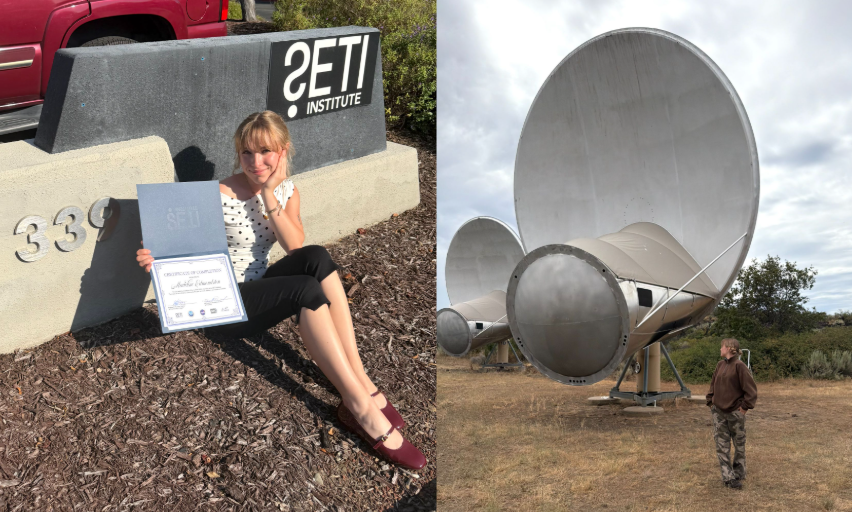
Madeline’s Experience: SETI Institute Astronomy REU
REU & SUMMER EXPERIENCE LIBRARY
-
REU & SUMMER EXPERIENCE LIBRARY -
Name: Name: Madeline Edmondston
Year: Rising Senior in Astrophysics at Michigan State University
Experience: SETI Astronomy REU
1. What REU did you participate in, and what year did you participate?
I participated in the SETI Institute REU during the Summer of 2026, between my junior and senior years.
2. What was your academic background when you applied?
When I applied, I was an Astrophysics major at Michigan State University with minors in geophysics, computational science, and classical studies. I already had some experience with coding and math, as well as previous research experience.
3. What was your research project, and what question were you trying to answer?
My project focused on Saturn’s F ring, which is the outermost ring of Saturn’s main ring system. The F ring is interesting because it exists near Saturn’s Roche limit, where you wouldn’t necessarily expect material to easily come together and remain there. It’s also extremely thin but dynamically complex because of its interactions with two of Saturn’s moons, Prometheus and Pandora. Voyager and Cassini gave us a lot of information about what was happening in the F ring, but only about half of the relevant Cassini images had originally been analyzed. My project involved going through the other images to learn more about the orbital dynamics of the ring.
4. What did a typical day or week look like?
SETI is a research institution, so it almost felt like having a research-based corporate job. It was generally a 9-to-5 environment, although the schedule was flexible. If I wanted to work from 10 to 6 instead, I could. It taught me a lot about managing my own time because I was primarily responsible for deciding how I spent my research hours. A few of us would carpool to SETI together. There were 13 interns, and we had a shared workspace with our own computers, monitors, and name tags. Throughout the week, we would work independently on our projects, meet with our mentors, and attend different program activities. Every Friday, we had a group meeting where everyone talked about what they had accomplished that week and what they planned to work on next.
5. Where did most of your research happen?
Most of my research happened at my computer. I had both my MacBook and a larger monitor, which was actually really helpful because the first part of my project involved looking closely at Cassini mosaics of Saturn’s F ring. A mosaic is a collection of images put together to create a larger view, and I needed the larger high-definition screen to really see the structures in the ring. I also did a lot of coding in Python using VS Code. I used an orbital dynamics integrator called REBOUND and coded an orbit fitter myself. After that, I used REBOUND to simulate what the different orbital elements would actually look like.
6. How much of your project was independent versus guided by your mentor?
My project was pretty independent, and my mentor was very laid-back about how I approached my work. We communicated through Slack and would usually meet every couple of days to talk about what I had done, what I was finding, and where I wanted to go next. I had guidance when I needed it, but I was also given a lot of responsibility for managing my own research.
7. Did you have prior experience with the skills your project required?
I came into the program with previous research, coding, and orbital dynamics experience from my work at Michigan State. Before my sophomore year, I reached out to Seth Jacobson, who leads the Planetary Makerspace at Michigan State, because I wanted to get research experience before applying to REUs. I ended up working remotely on lunar dynamics and the giant impact theory, looking at what conditions would have been necessary to produce a Moon like ours. At the same time, I still learned new tools and skills during the REU, especially working with Cassini mosaics, building my own orbit fitter, and using REBOUND for simulations.
8. How was the program structured? Were there organized workshops, seminars, or professional development activities?
The program had a lot going on outside of our individual research. We had weekly science talks from researchers who worked at SETI or were affiliated with the institute. There were also professional development talks. My PI, Matt Tiscareno, gave talks on things like grant writing, respecting others in research environments, imposter syndrome, giving presentations, and science communication. We also had a graduate student panel where people who had taken different academic paths answered our questions. There were two field trips as well. One involved visiting Lassen Volcanic National Park and learning about extremophiles, which are organisms that can survive in extreme environments that can serve as analogs for places like Mars.
9. What was housing like?
The program paid for us to stay at a long-term hotel, which was about a seven-minute drive from SETI. The lodge required government affiliation, and because of SETI’s affiliation with NASA, the program was able to make the reservations on our behalf. The hotel was very clean and welcoming, and having the other interns on the same hallway made it feel like we had our own little community.
10. Did you feel like you got to know the other students in your cohort?
Definitely! There were 13 other interns, and we spent a lot of time together both inside and outside of SETI. At the hotel, seven rooms on the same hallway were reserved for us, with two interns in each room. We had game nights, went places together, and because we were living and working around each other, it was pretty easy to become close.
11. What was transportation like? Did you need a car?
Transportation was probably one of the harder parts of being in Mountain View because there wasn’t much public transportation available to us. You could get to work by carpooling, but everyone also needed to do things like grocery shopping or go to other places outside of work. I mostly got around by ridesharing with another intern or friend.
12. Were there any expenses you weren't expecting? Was the stipend sufficient?
The program paid for my hotel, and I received around $7,000 in addition to transportation support. I felt like the stipend was enough, and I felt well compensated for the summer. It was actually a good experience for me in learning how to manage my own money. I was initially nervous about spending because I still wanted to make sure I was saving, but I was able to enjoy the summer while still having money left over. I went skydiving, attended concerts, went shopping, and visited San Francisco. I got to do a lot of things I had never done before without feeling like I had spent everything I earned.
13. Did your research lead to anything afterward?
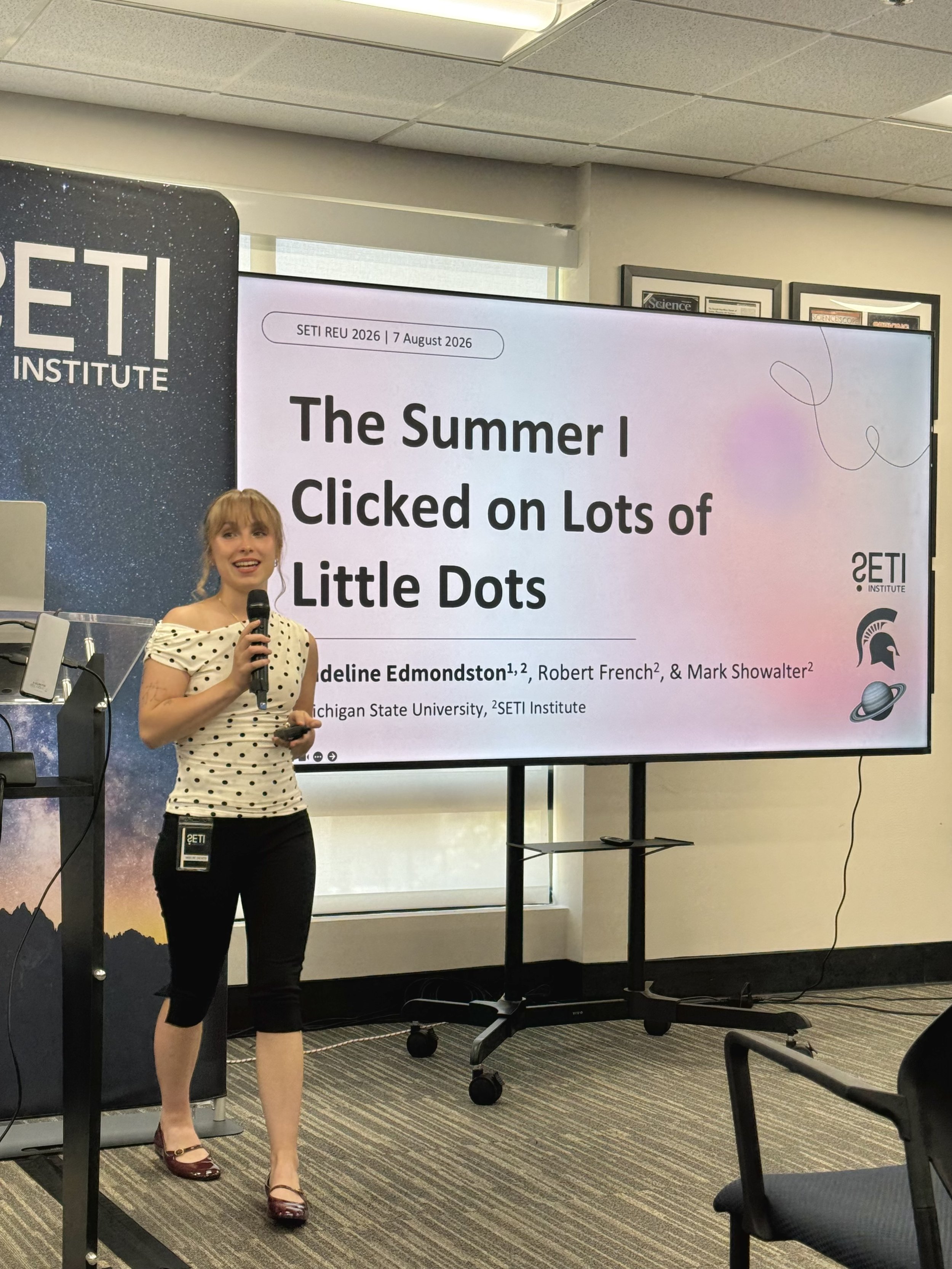
Yes, at the end of the program, I gave an 11-minute research presentation followed by four minutes of questions, and I also completed a research essay. The project is continuing beyond the REU as well. My SETI mentor will be my advisor for my senior thesis, so I’m continuing the work during my senior year. We also plan to write and publish a paper based on the work I did over the summer, and SETI is funding my participation in the DPS Conference.
14. What was the most challenging part of your REU?
The most challenging part for me was imposter syndrome. With research, you’re always focused on whatever the next step is, so it can be hard to recognize how much progress you’re actually making. There were times when I didn’t realize how much I had accomplished until my mentor pointed it out to me. I honestly wish I could see myself through other people’s eyes sometimes and give myself more credit for the progress I’m making.
15. What advice would you give a student applying to this REU?
For SETI specifically, pay close attention to what they ask for in the application. Only the materials you submit for the SETI-specific application through NSF ETAP are evaluated. I would also make sure you have a meaningful relationship with the people writing your recommendation letters because someone who actually knows you and your work will have much more to say about you. Prior research experience is also helpful; everyone in my cohort had some previous research experience. Additionally, apply broadly to REUs. I applied to 26 REUs because I really wanted to get into one, and SETI was the only one I got. There genuinely is such a slim chance with these programs, so don’t take the rejections as a sign that you aren’t qualified. You only need one “yes.”