Allyson’s Experience: University of Florida Astronomy Summer Undergraduate Research at Florida (SURF)
REU & SUMMER EXPERIENCE LIBRARY
-
REU & SUMMER EXPERIENCE LIBRARY -
Name: Allyson Garcia
Year: Rising Senior and Bunton-Waller Fellow at Penn State
Experience: University of Florida Astronomy Summer Undergraduate Research at Florida (SURF)
1. What REU did you participate in, and when did you participate?
I participated in the Summer 2026 University of Florida SURF REU in Astronomy.
2. What was your academic background when you applied?
I started college in astrophysics but eventually switched to planetary science because I wasn't able to take a required class on time, which would have held me back. I only had four years of funding through my Bunton-Waller Scholarship, so graduating on time was important to me. I decided to major in Astronomy and Planetary Sciences while supplementing my degree with additional math and physics courses. When I applied, I had taken introductory Physics I/II and Calculus I/II. Research-wise, SURF was my third research experience.
3. What was your research project, and what question were you trying to answer?
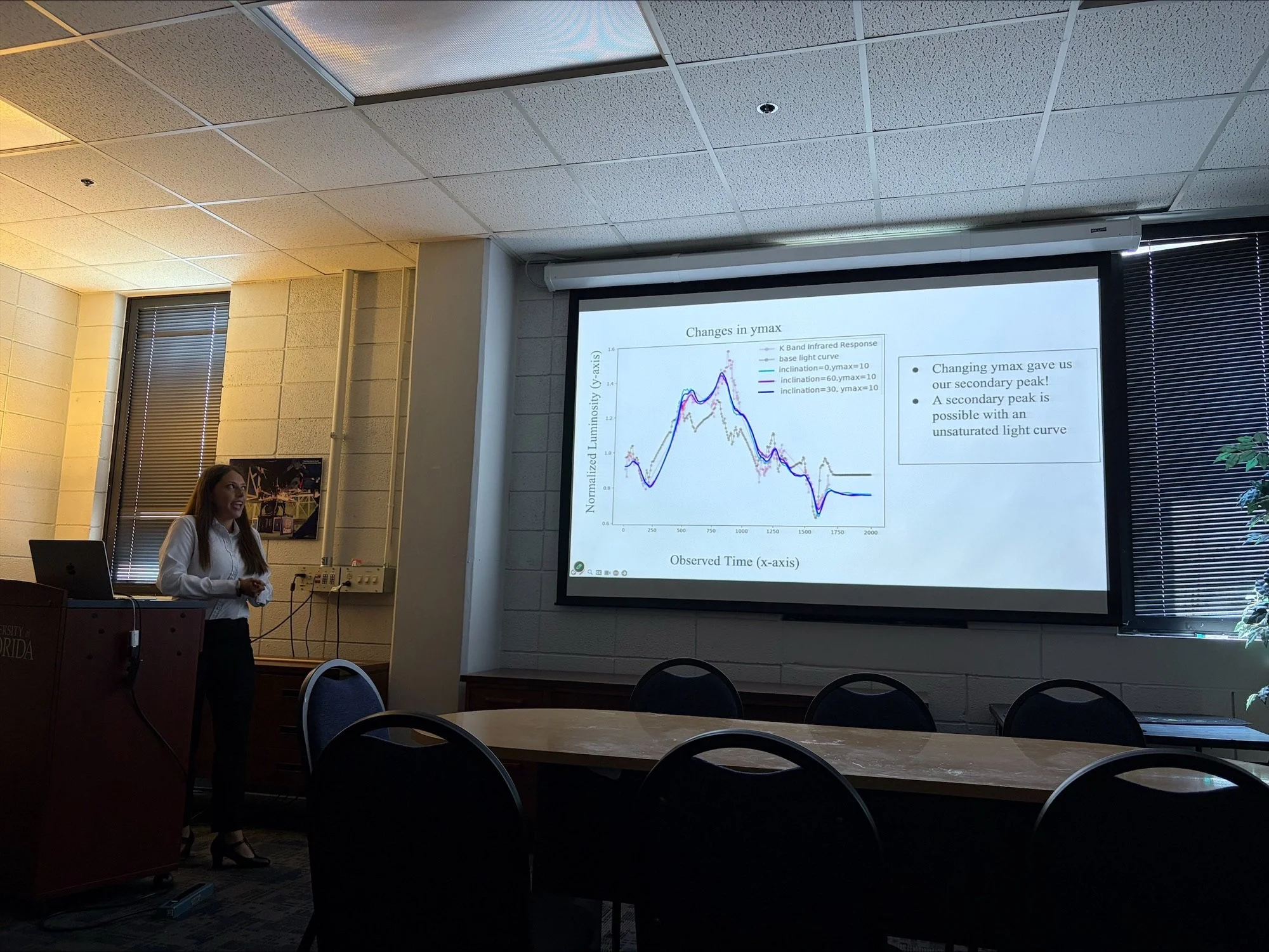
My project was “Modeling the Dusty Torus in NGC 3787.” I was studying theoretical models of the dusty torus surrounding an active galactic nucleus and looking at how changing different geometrical parameters using TORMAC, our theoretical reverberation mapping code, affected the infrared light curves we produced. The observed infrared light curve had two peaks, but the theoretical models weren't reproducing that second peak. My goal was to explore the model parameters and see what conditions could reproduce what we were actually observing. During my first week, I mostly read literature, got back into coding, and familiarized myself with the geometrical parameters in the code. From there, it became a process of asking, “What might be the reason we aren’t getting our secondary peak?” I started by turning off cloud saturation in our code, which is when our clouds reach their sublimation radius and are capped off by TORMAC, which no longer gives us a full picture of the dusty torus. Then, I started with existing best-fit models from saturated cases, and running unsaturated cases from them. I ran about 60,000 grids, and from there, the process was understanding which parameters affected what within my theoretical infrared response light curve. Two of them were inclination and the p-value, which describes how concentrated the clouds are distributed within the volume. I also experimented with y-max, which is the ratio of the outer region of the torus to the inner and describes how far the torus extends outwards. It was really cool when I finally started seeing that second peak appear in the models.
4. What did the actual research look like day-to-day, and where did most of it happen?
My research was computational, so most of it happened at my computer. I used Python, Jupyter Notebooks, Anaconda, Matplotlib, NumPy, Excel, and SQL. SQL was newer to me, so I had to learn how to pull specific information from datasets. Midway through the summer, I also started using the University of Florida’s supercomputer, HiPerGator, to run my best-fit grids. My REU provided me and my cohort with a classroom to do our work in, but because there was construction, we eventually migrated down to the basement space.
5. How independent was your research, and who did you work with?
My research was more hands-off, which I really enjoyed. It never felt like I couldn't meet with my mentor when I needed to, but I was given a lot of independence, especially once I started running my own unsaturated grids. That gave me a sense of responsibility for my project. I also didn't feel as pressured to mess up when I was working independently because I had room to try things and figure them out. A graduate student also worked with me and helped me throughout the project. Sometimes we would body double and work alongside each other.
6. Did you already have the skills you needed, or did you learn them during the REU?
I came in with some coding and research experience, but there were still things I had to learn during the summer. I had to use SQL, which was newer to me, and I learned more about working with large datasets and pulling out the specific information I needed.
7. How often did you interact with your mentor, and what did mentorship look like?
I met with my PI at least once a week, usually every Monday. We would go over what I had done the previous week and make an agenda for what I should focus on next. If I needed more help or was preparing for a practice talk, we could meet more than once that week. Even though the mentorship style was hands-off, I never felt like my mentor was unavailable to me.
8. How structured was the program outside of research? Were there workshops, seminars, professional development activities, or social events?
Every Wednesday, the entire cohort had lunch together and we would have speakers from all backgrounds give STEM and professional development talks. We learned things like how to search for papers, use arxiv, cite papers correctly, and create our own research libraries. We also talked about how to evaluate the pros and cons of different papers. Other sessions covered topics like applying to graduate school and science communication. The program also organized trips every other weekend. We went to places like St. Augustine, an equestrian center, and Kennedy Space Center.
9. Did you get to know your cohort? What was the social environment like?
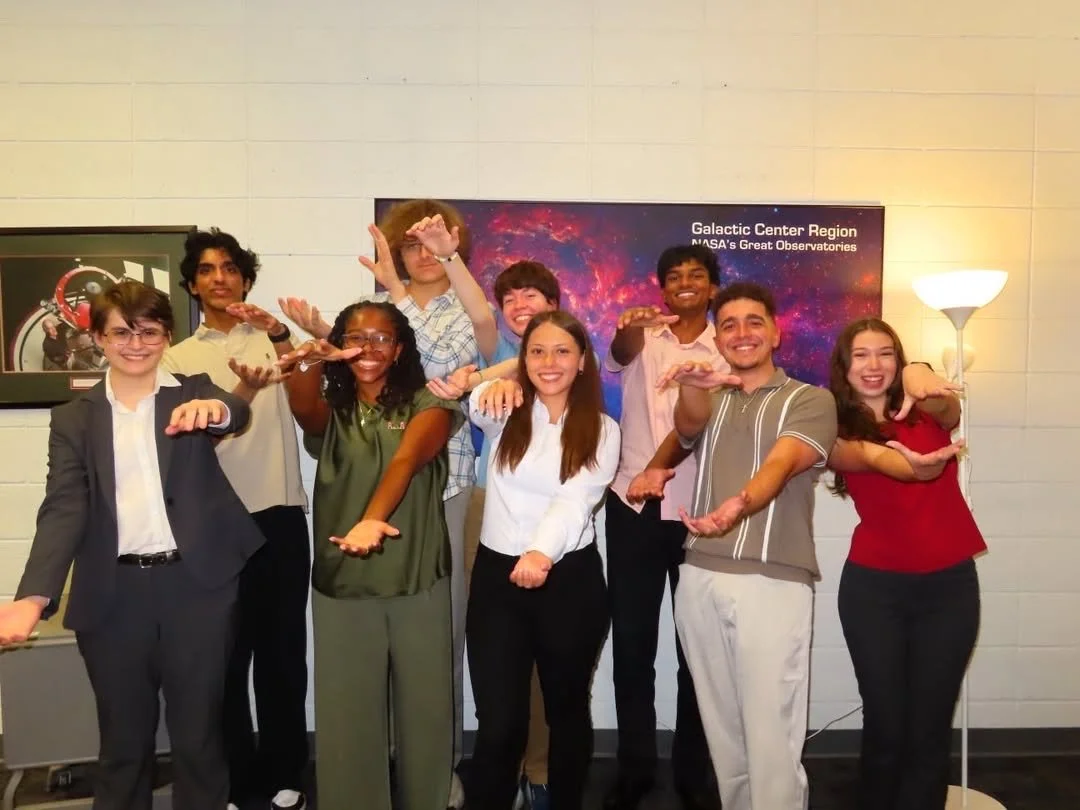
Yes, we became really close. There were nine of us, and we spent a lot of time together both during and outside of work. We played Mafia, watched the World Cup, played volleyball, and hung out whenever we got out of work early. I also went to Universal with people from my cohort. Even though everyone was busy during the weekdays, we still found ways to spend time together.
10. What was housing like?
Housing was provided, and it was really nice. We stayed in an apartment complex where we each had our own bedroom. The apartments had two bathrooms and a kitchen.
11. What was transportation like? Did you need a car?
We had access to shuttles and buses, and depending on where you were going, you could also walk. I didn't need to rely on having my own car.
12. Was the stipend enough? Were there expenses you weren't expecting?
For me, the stipend was sufficient, especially because transportation and housing were provided. We didn't receive a separate meal stipend, so I did a lot of grocery shopping, but I personally didn't have financial issues with the amount we were given.
13. What was the most challenging part of your REU?
I would say weeks three through six were the hardest for me because I started experiencing a lot of imposter syndrome. I would hear my peers talking about all of the upper-level classes they had taken, and I felt like I was behind. Some of them were also making what looked like significant progress on their projects while I felt like I was still working on the same thing. I started wondering, “Am I moving too slowly?” I eventually talked to one of the graduate students about it, and they helped me realize how quickly research progress can build toward the end. It felt like pushing a big boulder up a tall hill. Once I finally got access to HiPerGator and began running my new sets of grids, everything started moving really fast.
14. Did your research lead to anything after the summer?
Yes. The graduate student I worked with is working toward publishing a paper based on the research we were doing, and I am planning to be a co-author. I also have the opportunity to continue working on the project. Once I get situated, we'll reconnect about future work, including running more models. My mentors are also supporting me with graduate school recommendations, and the program is providing funding for us to attend the 2027 AAS meeting in Utah.
15. What advice would you give a student applying to an REU?
Comparison is the thief of joy. I remember listening to my peers talk about all of their upper-level classes and backgrounds while I had only gone up to Calculus II. It was easy to think, “They've taken upper math and physics courses, and I haven't so they must be smarter, or better than me” but I also had more research experience than some of them. Someone having experience that you don't have doesn't make them better than you, and having experience that they don't have doesn't make you better than them. Everyone has their own path. Make the most of your own experiences, and don't let someone else's experience slow yours down.