Hung’s Experience: Max Planck Institute for Astronomy
REU & SUMMER EXPERIENCE LIBRARY
-
REU & SUMMER EXPERIENCE LIBRARY -
Name: Hung Nguyen
Year: Astrophysics & Computational Mathematics Senior at Michigan State
Experience: Max Planck Institute for Astronomy
1. What summer experience did you participate in, and what year did you participate?
This past summer, I participated in the summer internship program at the Max Planck Institute for Astronomy (MPIA) in Germany. It was honestly one of the most competitive internships I applied to. There were around 1300 applicants for only 11 projects. At the time of the internship, I had just finished my junior year at Michigan State University.
2. What was your academic background when you applied?
I had a pretty extensive research background coming into the program. Academically, I had completed much of the astronomy curriculum, including coursework on stars, although I had not taken galaxies yet. I had also taken cosmochemistry, differential equations, and machine learning. Those courses gave me a strong background in mathematical logic, problem solving, and the type of reasoning I ended up using throughout the project.
3. What was your research project, and what question were you trying to answer?
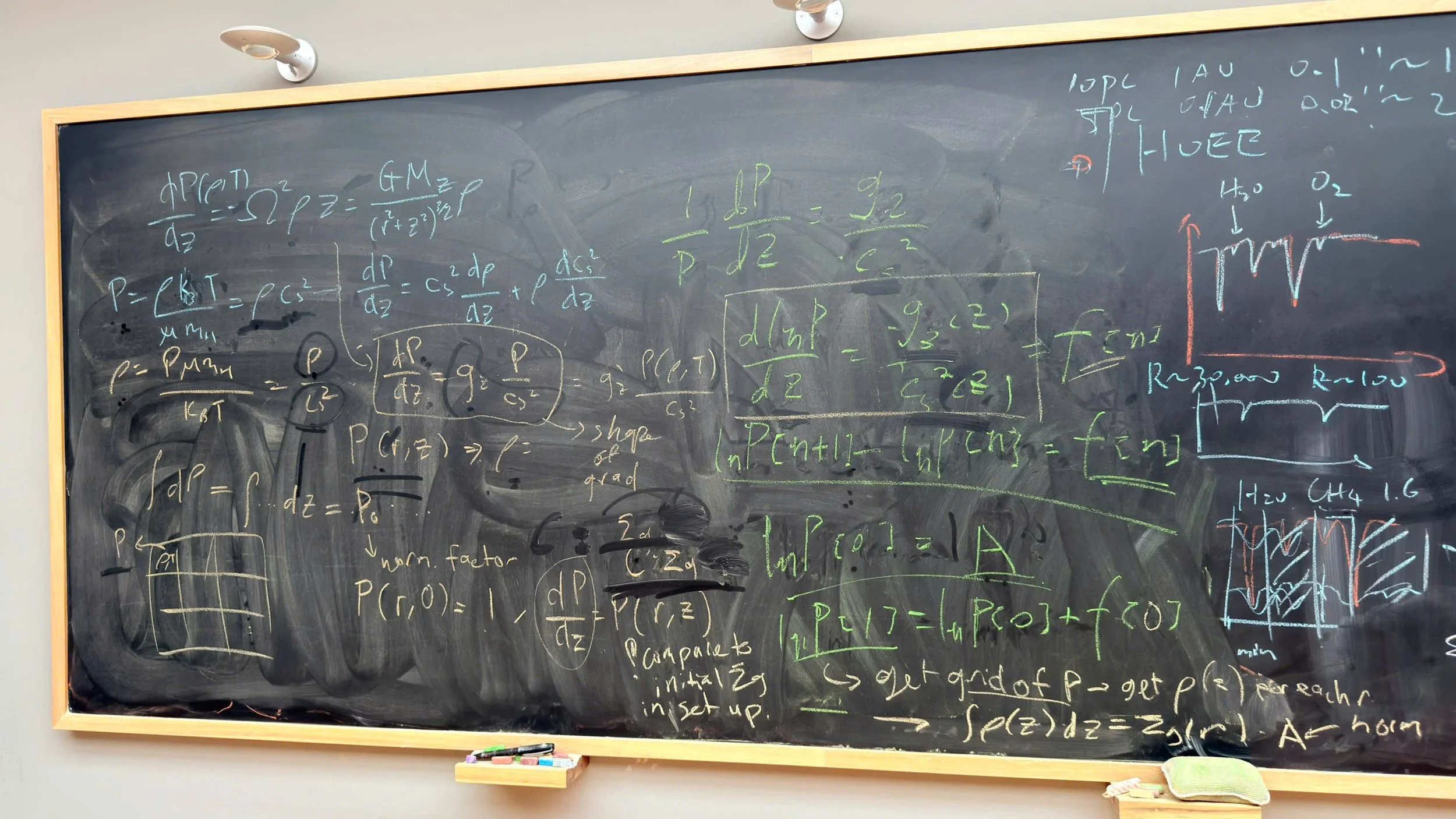
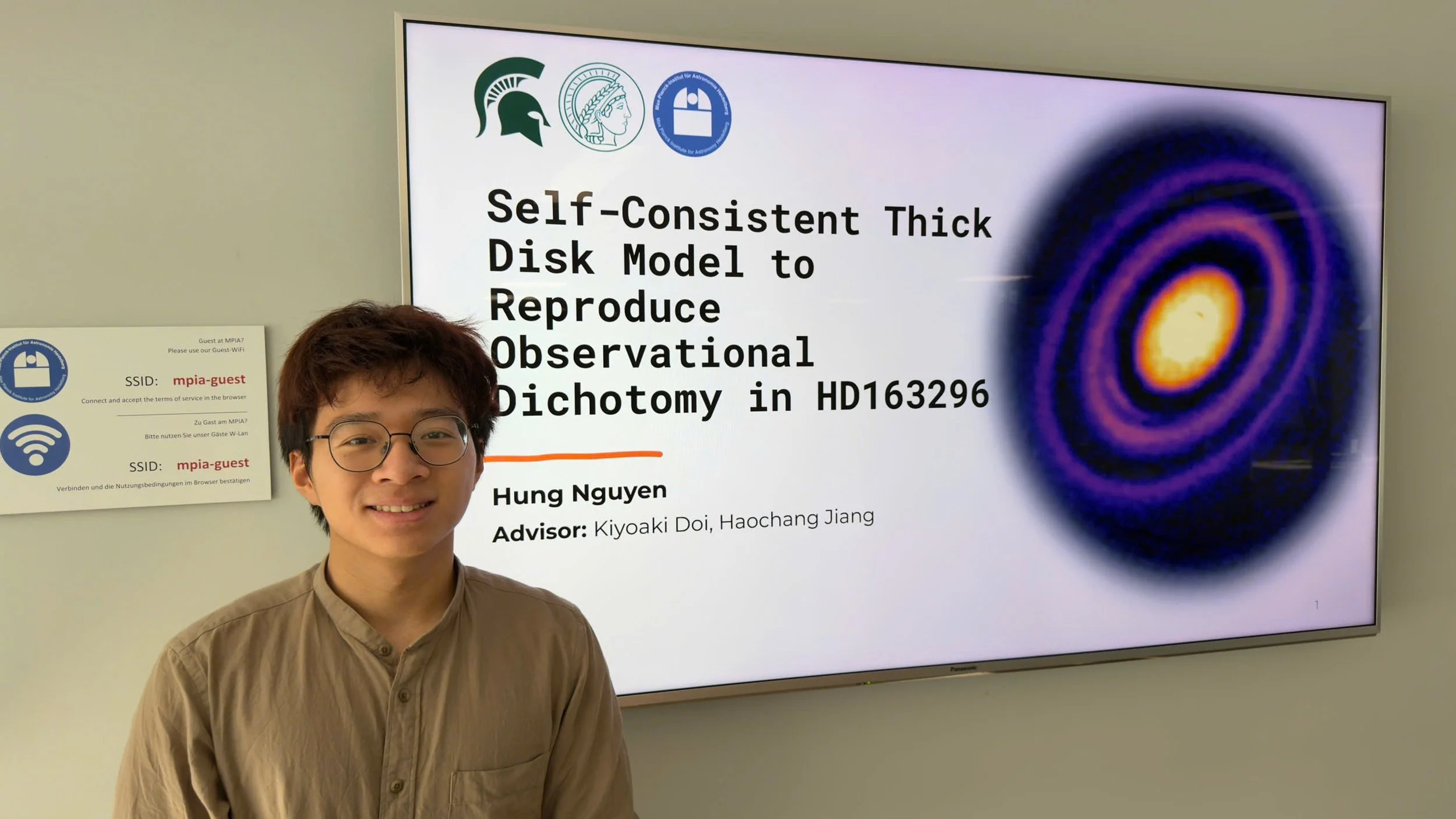
I worked with two postdoctoral researchers who are fellows in the planet formation group at MPIA, studying protoplanetary disks. My project focused specifically on creating a self-consistent protoplanetary disk model to reproduce the observational characteristics of HD 163296 and to understand how dust and gas interact within it. I had to build the model from scratch. We would begin with an initial assumption about the temperature and dust composition of the disk, then solve for parameters like the gas density and dust density. We would repeatedly update those values with the goal of eventually reaching an equilibrium state. Once the inputs and resulting outputs agree with one another, the model is considered self-consistent.bThe model starts with an initial temperature and uses differential equations to solve for the gas density at specific locations within the disk. We then extrapolate that across a grid representing the disk. The gas density is determined using hydrostatic equilibrium. Essentially, the gravitational force pulling the gas inward has to balance the pressure gradient pushing it outward.
We also had to model vertical mixing of dust. This depends on properties of the dust grains and how strongly they are coupled to the gas. Smaller dust grains tend to be more strongly coupled to the gas, while larger grains are more likely to settle. We had to solve for the equilibrium between those competing processes. The first few weeks were probably the most difficult part because there was a lot of new math, physics, and computational work to learn before I could really begin building the models.
4. What did a typical day or week look like?
MPIA is located on top of a mountain, so getting there could be difficult because the bus only comes about once an hour. I was lucky enough to stay in the guest house at the institute, so I lived right across from where I worked. I usually woke up around 7 a.m. and got to the office around 8. I might start the morning by reading papers or looking through new papers on arXiv. On some days, I would also spend time working on my research back at Michigan State. I have a paper related to lunar formation coming soon, so I was balancing that work as well.
At MPIA, the coffee social started around 10:30 a.m., which was a good opportunity to talk with other researchers about what they were working on. Lunch was around 12:15 every day and usually lasted about an hour. After lunch, we might play ping pong or foosball in the basement before going back to work. My afternoons were usually very coding-heavy, which could get exhausting, so I would normally leave around 4 or 5 p.m. Once I went home, I tried not to think about work anymore. One thing I appreciated was that there was not a lot of pressure surrounding strict deadlines or mandated reports. I was working alongside some of the smartest people in the world, but I could still ask for guidance and learn in an environment where the people around me inspired me to be productive.
5. Where did most of your research happen?
Most of my research happened in my office at MPIA. I had my own workspace with a large monitor and keyboard. I technically was not required to come into the office every day, but I preferred working there.
6. How much of your project was independent versus guided by your mentor?
The project was mainly independent, but I always had access to guidance when I needed it. My mentor would give me tasks or explain what needed to be accomplished, but figuring out how to actually implement those ideas was usually up to me. A lot of the work involved figuring out how to translate the physics into code and troubleshooting when something did not work. If I had a question or ran into a problem I could not solve, I could go to my mentor's office and ask for help. I liked having that balance because I had the independence to figure things out on my own without feeling like I was completely on my own.
7. Did you have prior experience with the skills your project required?
I had prior experience with Python, but this project pushed me to use it in much more computationally intensive ways. The simulation work involved high-performance computing, Linux, Bash, and numerical methods. I became much more comfortable with Linux simply from having to use it every day. I also had to solve differential equations numerically and use tools within NumPy, including numerical integration methods such as the trapezoidal rule. We coupled our models with RADMC-3D, a radiative transfer code. We would provide RADMC-3D with a grid containing the density structure, and it would use Monte Carlo radiative transfer calculations to determine the corresponding temperature structure. I also used AI tools, particularly Claude, to help me work through implementation problems while coding. Overall, I came in with some of the foundational skills, but I gained a lot of practical experience by actually having to use them in a research environment.
8. Were there workshops, seminars, professional development activities, or cohort activities?
There were a lot of opportunities to interact with researchers outside of my specific project. MPIA had coffee socials around 10:30 a.m., where I could talk with other researchers about their work and what was happening around the institute. There were also colloquia around 11 a.m. on some days. The topics covered everything from galaxies to planets, although there happened to be a lot of planetary scientists visiting while I was there.
9. Did you get to know the other students? What was the social environment like?
Yes, several of us lived together in the guest house. We would sometimes play ping pong or foosball after work. The social environment was pretty relaxed. Even though I was surrounded by people doing really advanced research, it did not feel like I was under constant pressure.
10. What was housing like?
The housing was nice. There were four rooms, and each of us had our own private bedroom and bathroom while sharing a kitchen. The space was also regularly cleaned, which made living there pretty comfortable.
11. What was transportation like? Did you need a car?
You did not necessarily need a car, but transportation could be inconvenient because MPIA is on a mountain. The bus only came about once an hour, and there was nowhere on the mountain to buy groceries or other necessities. Groceries were probably the biggest logistical problem. I tried to shop about once a week because if I ran low on food at night, there really was not anywhere nearby to get more. Sometimes getting back up the mountain could also mean paying around €50 for an Uber if I missed the bus or could not use public transportation. On the positive side, groceries in Europe were much cheaper than what I was used to in the United States. I spent around €50 a week on groceries.
12. Was the stipend sufficient? Were there unexpected expenses?
For normal living expenses, the stipend was sufficient. However, if you wanted to take advantage of being in Europe and travel, it was not really enough to cover everything. France, for example, was only about 30 minutes away, so there were a lot of opportunities to travel that could quickly become additional expenses.
13. What’s something that you got out of this experience?
The most important thing I got from the experience was understanding what it is actually like to be a researcher and work on research every day as a 9-to-5 job. During the final week of my project, we encountered a fundamental problem with the self-consistent model related to thermal wave instability. Because the temperature and flux changed with each iteration, the model could not truly reach convergence or the equilibrium state we were trying to achieve. That ended up teaching me something important about the nature of research. You are going to encounter difficulties, and you may have projects or approaches that simply do not work the way you expected. When that happens, you have to return to the literature, understand what other researchers have tried, and look for possible solutions.
The experience made me realize that I actually enjoy that process. I enjoy searching for a solution, seeing what people have done in the past, implementing those ideas, and testing whether they work in my own model. Even though I did not end the summer with the physical result we originally expected, I realized that the process of trying to solve those problems is what drives me to continue doing research.
14. What advice would you give a student applying to an REU?
Keep applying, even when you do not get in the first time. A friend once told me not to be afraid to dream big, but to take every application seriously. He applied three times before finally getting accepted. My own experience was similar. Last year, I applied to around 12 programs and did not get into any of them. This year, I applied to around 20 different places, and Max Planck was the only program I was accepted into. It also happened to be one of the most competitive programs I applied for. One rejection cycle does not mean you are not capable of doing the research. Keep improving your applications, keep building your skills, and keep trying. Sometimes you only need one program to say “yes”.