Laila’s Experience: University of Wisconsin Astrophysics REU
REU & SUMMER EXPERIENCE LIBRARY
-
REU & SUMMER EXPERIENCE LIBRARY -
Name: Laila Jones
Year: Rising Senior at Batten University
Experience: University of Wisconsin Astrophysics REU
1. What REU did you participate in, and what year did you participate?
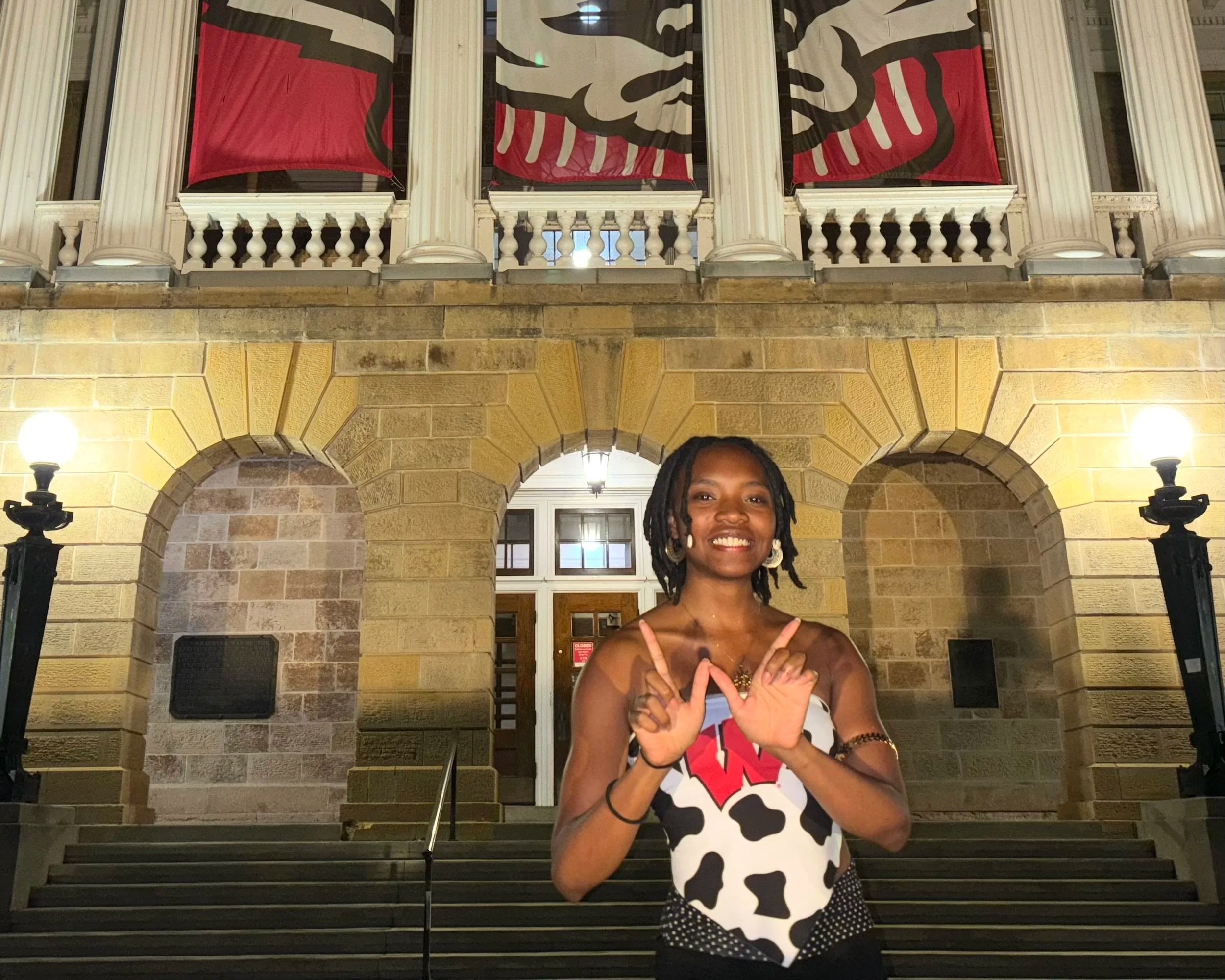
I participated in the University of Wisconsin Astrophysics REU during the summer of 2026, after my junior year.
2. What was your academic background when you applied?
I was an Earth and Environmental Science major with minors in Math and Environmental Studies. My university doesn't have an astronomy or physics program, so before applying, I had only taken Physics I and Astronomy I. I also didn't have coding experience.
3. What was your research project, and what question were you trying to answer?
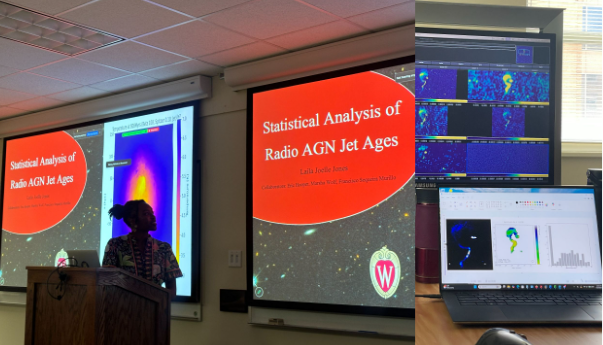
I worked on Active Galactic Nuclei (AGN) feedback and specifically focused on age-dating AGN sources. I used broadband radio data and a long Python script called BRATS (Broadband Radio Astronomy ToolS) to spectrally age-date. I also worked on creating spectral aging maps and error maps and analyzing the statistical side of the data.
4. What did a typical day or week look like?
My days involved waking up, going to meetings, and then spending hours coding. I would also take breaks throughout the day and spend time with the other students in my cohort. That first week, I was still trying to understand things as basic as how to write a loop in Python. I quickly realized that a lot of what I was going to be doing was coding. It showed me how much astrophysics can really become data science, and there was definitely a learning curve. I remember one of the girls in my cohort helping me write my first function in Python, and I watched a lot of tutorials throughout the summer to build my skills.
5. Where did most of your research happen?
My research was computational, so most of my work happened at a computer. I wasn't required to sit in one particular lab or office all day, though. I was encouraged to work in different cafés and buildings around the city, so I had a lot of flexibility in where I actually did my research.
6. How much of your project was independent versus guided by your mentor?
I would say my project was pretty guided by my mentors. We had a general idea of what we wanted to accomplish, and then I would go work on the code and produce some plots. I would bring those results back to my mentors, get feedback, and then receive another set of tasks. Sometimes that meant re-coding something or figuring out how to make a better plot. It was very task-and-results based. The statistical part of the data analysis was one of our main priorities.
7. Did you work primarily one-on-one with a mentor, as part of a larger research group, or mostly independently?
I worked as part of a small research group. I had two PIs who were married, as well as a graduate student who worked with us. I jokingly thought of them as my research mom, dad, and brother because I had all three of them supporting me throughout the project.
8. Did you have prior experience with the skills your project required?
Not really. I came into the program without coding experience and had to learn Python during the summer. I was learning everything from writing basic loops and functions to eventually working with astronomical data, creating plots, and doing statistical analysis. Before the REU, I didn't even know what a FITS file was, and I had never used a Jupyter Notebook. One thing I really appreciated about this REU was that it provided opportunities for students who may not look the most prepared on paper. I was one of the least prepared when it came to coding, but the program was very understanding about that. They provided coding boot camps and other resources that helped fill in those gaps, and I learned Python throughout the summer.
9. How was the program structured? Were there organized workshops, seminars, or professional development activities?
Yes, every Monday we had professional development workshops. We covered topics like managing conflict, collaborating effectively, and research ethics. We also had a science talk each week where researchers from different areas of astrophysics would come speak with us, so we were exposed to fields outside of our individual projects. On Wednesdays, we also had a check-in with the head of the REU program.
10. Did you feel like you got to know the other students in your cohort?
Definitely! There were eight of us, we were all girls, and we lived in the same residence hall, so we became really close. My cohort also became part of my support system academically. I came in feeling behind because I didn't have the same coding or astrophysics background as some of the other students, but we helped each other.
11. What was housing like?
We lived together on campus in the same residence hall, which made it really easy to spend time together and become close as a cohort.
12. What was transportation like? Did you need a car?
I didn't need a car. There was plenty of public transportation, and there was also an electric bike system. I was biking around the city all the time. Having a walkable campus and being able to get around without a car was one of the things I really enjoyed about the experience.
13. Were there any expenses you weren't expecting? Was the stipend sufficient?
We received around $7,800 total, with about $800 allocated for food. We received about $5,800 of that total stipend toward the beginning of the program, and the remainder was dispersed at the end of the program. I personally would have liked to have had more money allocated for food. We were grocery shopping throughout the summer, so that was something I had to account for.
14. Did your research lead to anything afterward?
Yes. The REU is paying for all of us to present our research at the AAS meeting in Utah in January. I'm also personally presenting my research at the National Society of Black Physicists conference. Beyond my astronomy project, I made connections with people in the Atmospheric and Oceanic Department while I was at UW Madison, and I have potential collaborations in progress with people I met there.
15. What advice would you give a student applying to this REU?
Expect a learning curve, but also learn how to balance having fun with doing your research. For me, I probably had a little too much fun at first. I think I could have progressed further in my project if I had dedicated more time to the research earlier in the summer. The reality that the program was almost over didn't really hit me until there were about five weeks left. Additionally, I would say to enjoy the experience, spend time with your cohort, and explore the city, but remember that ten weeks goes by quickly. Finding that balance early will make a big difference. I also wish I had known to expect a learning curve. You don't necessarily have to enter an REU already knowing how to do everything your project requires. I came in without Python experience, without knowing what a FITS file was, and without ever using a Jupyter Notebook. I was able to learn those things throughout the summer.