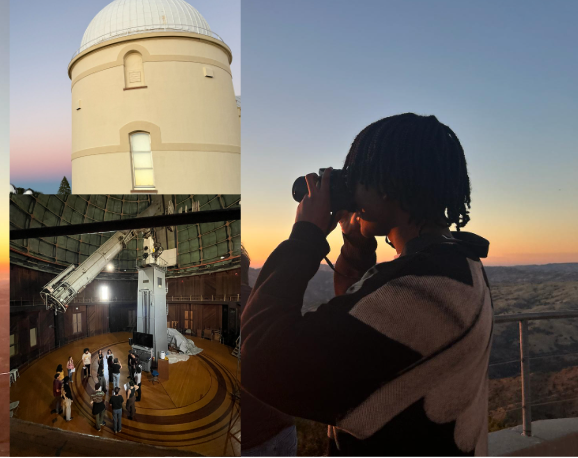
Maurice’s Experience: University of California, Santa Cruz Lamat Fellowship
REU & SUMMER EXPERIENCE LIBRARY
-
REU & SUMMER EXPERIENCE LIBRARY -
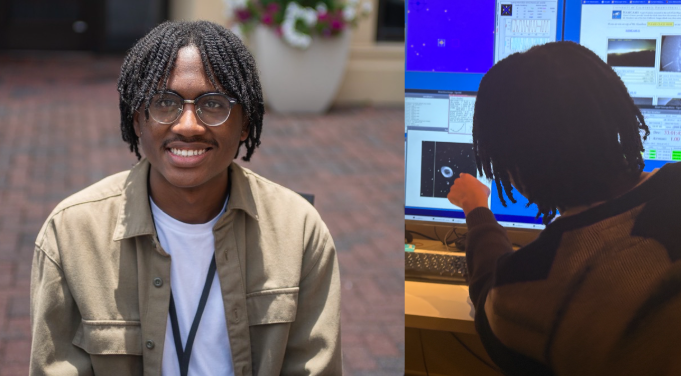
Name: Maurice Abraham
Year: Rising Junior in Astrophysics at the University of Florida
Experience: UC Santa Cruz Lamat Fellowship
1. What REU did you participate in, and what year did you participate?
I participated in the UC Santa Cruz Lamat Fellowship Program during the summers after my freshman and sophomore years, in 2025 and 2026.
2. What was your academic background when you applied?
When I applied, I was in my first semester as a freshman at the University of Florida. I had an Associates degree from dual enrollment, and I had Physics I, Calculus III, and a Python course.
3. Why did you apply to this particular program?
I applied because Lamat was one of the programs that was accessible to me as a freshman. A lot of programs require recommendation letters, and as a first-semester freshman, I was thinking, “None of these professors know me like that yet.” Lamat gave me an opportunity to explain my interests and the experiences I did have instead of expecting me to already have an extensive research background.
4. What was your research project, and what question were you trying to answer?
My first Lamat project was also my first research project ever. In summer 2025, I studied disintegrating exoplanets. These are planets that orbit extremely close to their host stars, where temperatures can reach around 3,000 degrees Kelvin. At those temperatures, material from the planet can essentially melt and be ejected, creating something similar to a comet tail. Over time, the planet can completely disintegrate. They're extremely rare, there are only a few confirmed disintegrating exoplanets so we were interested in understanding their disintegration rates. One way we detect these planets is through their light curves. Due to the planet's tail, the transit can look stretched out, and the transit depth can change each time we observe it. I worked with planet-fitting software to understand how these characteristics interacted with the light curve.
When I returned to Lamat in Summer 2026, I was able to choose from new project options. My second project focused on neutron star merger simulations and the formation of heavy elements like gold and uranium. Neutron star mergers happen at extremely high temperatures and densities, and there are a lot of physical processes happening that we still don't completely understand. I was particularly interested in what happens to magnetic fields during the merger. Magnetic field lines can become stretched within the plasma and eventually reconnect. My project looked at how that process could affect the temperature and evolution of the system.
5. What did a typical day or week look like?
There was a lot of freedom in when I worked, especially because my research was computational. Unless your project required you to physically be in a lab, you could structure your research time in a way that worked for you. A normal day could be going to the office, working on my research, getting lunch, going back to work, and then going home around five or six. It gave me a good sense of what research could actually feel like as a career. There wasn't homework waiting for me when I got home and there weren't exams to study for. I could work during the day and then actually have a life outside of work.
6. Where did your research happen, and what did you spend most of your time doing?
Both of my projects were primarily computational and theoretical. I spent most of my time at a computer working with simulations, code, and research software. I also had flexibility. If I wanted to work at night or at a different time of day, I could.
7. What tools, programming languages, or research techniques did you use?
Python was the main programming language I used. The strongest technical experience I had when I first applied was the Python course I was taking at UF. Lamat also provided a coding boot camp and Python tutoring hours during the program, so having coding experience was helpful, but you didn't need to come in already knowing everything.
8. How independent was your research, and what was it like working with your mentors?
I've experienced two different styles of mentorship through Lamat. During my first project, my mentor was from my home institution (University of Florida), so our mentorship was entirely online. We had a dedicated day each week when we would meet and talk about my progress, but he was also available outside of those meetings. I could send him updates or text him if I needed help. When I returned to LAMAT, my mentorship was in person. We still had a set day each week to meet, but being in person meant we naturally spent more time getting to know each other and working together. If I needed help, we could also decide to meet again the next day instead of waiting another week. Both experiences gave me independence while still making sure I had someone available when I needed support.
9. How was the program structured? Were there workshops, professional development activities, or social events?
Yes, Lamat had workshops throughout the summer, including programming that focused on navigating research and our experiences as people from marginalized backgrounds. We were able to talk about things that you don't always get the opportunity to discuss in traditional academic environments. There were also astronomy talks that exposed us to research outside of our individual projects. Those talks were actually really important for me because they introduced me to different areas of astrophysics and helped me discover new research interests. Additionally, the cohort was one of my favorite parts of the program. Everyone was really connected, and because we lived near each other, it was easy to spend time together outside of research. We went to comedy nights, trivia, beach bonfires, the boardwalk, and other events together. The cohort also became another source of support. If you needed help with something, there were people around you who understood what you were going through.
10. What was housing like?
We stayed in housing at UC Santa Cruz. Everyone had their own bedroom, usually in a unit with around three or four bedrooms, along with shared spaces like a kitchen and bathroom. Having a kitchen meant we could grocery shop and cook for ourselves.
11. What was transportation like? Did you need a car?
I didn't need a car. The bus system made it possible to get around campus and the surrounding area. Some people in the cohort did have cars, so we could also carpool when we wanted to go somewhere that was harder to reach by bus. UC Santa Cruz is beautiful. The campus feels like you're living in a forest. You can be walking somewhere and see deer or turkeys along the way. Being in Santa Cruz also gave us opportunities to go to the beach, the boardwalk, and other places around the area.
12. Was the stipend sufficient?
For me, the stipend was enough to participate in the program and afford things like groceries while I was there.
13. What surprised you, and what was the most challenging part of the REU?
The biggest challenge was realizing how much information you have to learn in such a short amount of time. You have around eight weeks to learn the science behind your project, understand the code, learn new packages, and then actually complete the research. It can be overwhelming, and imposter syndrome can definitely come with that. What helped was that Lamat understood that learning curve. There were workshops built around those experiences, tutoring hours were available, and my mentors were willing to sit down and explain things when I didn't understand.
14. Did your research lead to anything afterward?
Lamat has opened a lot of the doors I have now, and I'll always be grateful for that. They connected me with a mentor at my home institution so I could continue doing research during the school year. They also helped me attend conferences and pursue scholarships and other opportunities. I presented my research at the National Society of Black Physicists conference and received the Beth Brown Memorial Award for my poster. Lamat provided funding that allowed me to attend.
15. What advice would you give a student applying to Lamat?
Look into Lamat before you apply. They have a lot of information and videos online, including longer videos where they talk about what the program is actually like. Having coding experience is nice, but it's not required. Don't count yourself out because you don't already know Python or haven't done research before. Most importantly, be open to the experience. Lamat can expose you to people, research areas, and opportunities you didn't even know existed. The astronomy talks and networking introduced me to completely different fields and ultimately helped shape the research I'm doing now.